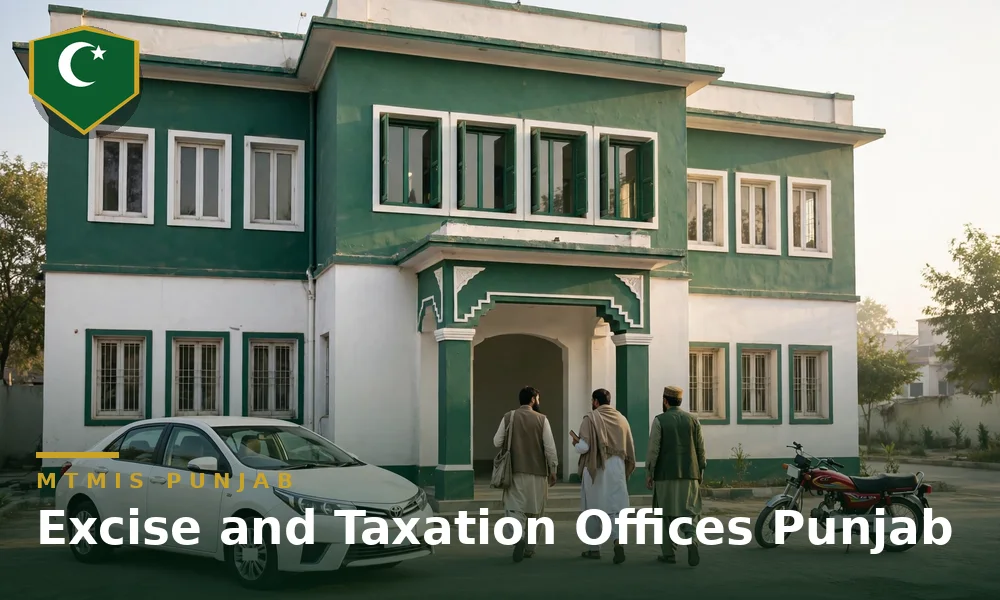
Excise and Taxation offices in Punjab: head office, district MRAs and helplines
The Excise and Taxation office network in Punjab runs on three levels: a head office in Lahore, regional offices over groups of districts, and a district office with a Motor Registration Authority (MRA) in every district. The Excise, Taxation and Narcotics Control Department holds the vehicle record of the province, and the district of registration holds the file of each vehicle. Most readings of the record and most payments now run online, and the office visit serves the file work alone. This guide states the structure of the network, the work of each level and the preparation for a counter visit.
Table of contents
- How the Excise office network is arranged
- The Lahore head office and the work it handles
- District Motor Registration Authorities and file work
- Work that runs online without an office
- Preparation for a counter visit
- Escalation and the complaint route
- Frequently asked questions
How the Excise office network is arranged
The Directorate General of Excise and Taxation heads the department from Lahore. Regional offices stand below the Directorate General, and the department contact list arranges the regions by city: Lahore, Rawalpindi, Faisalabad, Multan, Gujranwala, Sargodha, Bahawalpur, Dera Ghazi Khan and Sahiwal. Each region supervises the district offices in the group of districts under the region. An Excise and Taxation Officer heads the district office, and the district office carries the motor registration work of the district through the Motor Registration Authority.
The arrangement fixes one rule for vehicle owners. The district of registration holds the file of the vehicle, and file-level work follows the file. A vehicle registered in Multan keeps its file with the Multan authority, and a transfer correction, a duplicate document case or a record correction for that vehicle runs through the registering district. An owner in another district reads the record online from any place, and the owner travels to the registering district for the file work alone.
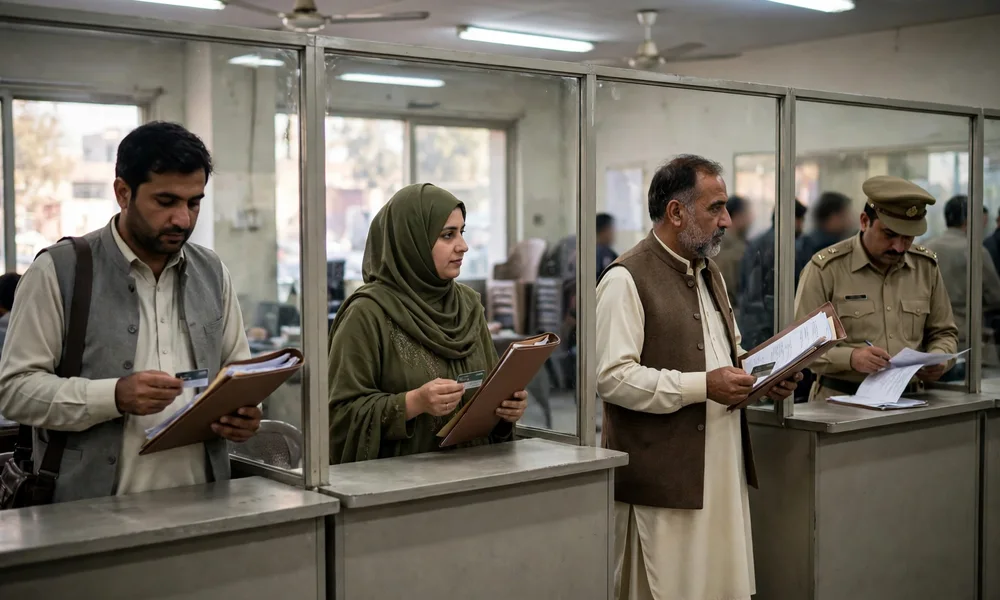
The Lahore head office and the work it handles
The department head office stands at Transport House, 11-A Egerton Road, Lahore, opposite Faletti’s Hotel. The head office carries policy, supervision and escalation for the province. The head office sets the schedules of fees and taxes, issues the directions that the regional and district offices apply, and receives the cases that a district office cannot settle. A routine registration, transfer or token tax case does not begin at the head office, because the district counters hold the files and the services.
Three kinds of matter reach the head office in the normal course. A complaint against a district office or an agent moves upward through the region to the Directorate General. A policy question, for example the reading of a fee schedule on a new vehicle class, rests with the head office. A case with a record dispute across districts rests with the head office as well, because no single district holds the full position. The department helpline 1035 gives the first guidance on each kind of matter, and the helpline directs the caller to the office that holds the case.
District Motor Registration Authorities and file work
The Motor Registration Authority of the district is the registering authority for vehicles of that district. The MRA keeps the registration file, records the ownership position and completes the counter transactions on the record. The table below states the division of work across the levels of the network.
| Level of the network | Work the level handles |
|---|---|
| Head office, Lahore | Policy, fee and tax schedules, escalations, inter-district record disputes |
| Regional office | Supervision of district offices, complaints against a district office |
| District MRA | Registration, transfer, duplicate documents, record correction, token tax counter work |
| Facilitation centre | Biometric verification and counter support services |
The district counter handles the transactions that change the file: registration of a vehicle in the district, transfer of ownership, endorsement changes on the record, duplicate registration documents and correction of a wrong record entry. The counter works against the physical file and the documents of the case. A smart card or a registration book alone does not complete a file case, and the officer calls for the file before the officer records a change. An owner carries the original documents to the visit, because the counter matches the documents against the file during the transaction.
MTMIS Punjab: the complete guide to online vehicle verification explains the record that every district office feeds, and the fields a reader sees on the verification result.
Work that runs online without an office
Four services run online from start to finish, and no office visit applies to the four services. Vehicle verification runs on the official portal at mtmis.excise.punjab.gov.pk. The form asks for the registration number, the registration date and the security code, and the result shows the engine number and the record of the vehicle. The result shows no chassis number. SMS verification runs beside the portal at 8785. Dues reading and payment run on ePay Punjab: the owner reads the dues for a registration number, receives a 17-digit Payment Slip ID (PSID) and pays through a bank application, an ATM or a mobile wallet. The appointment portal at appointment-excise.punjab.gov.pk books a counter window for the file work that still needs an office.
An owner settles every online step before a counter visit. The owner reads the record, reads the dues position and books the appointment, and the visit then covers the file work alone. The Punjab Information Technology Board (PITB) helpline 0800-08786 supports the online services and the appointment system, and the helpline confirms the working facilitation centre for biometric verification in a district.
How to book an Excise appointment online in Punjab states the booking sequence by function, from the opening of the portal to the confirmation message.

Preparation for a counter visit
A counter visit succeeds on the file and the documents, and preparation decides the outcome before the owner leaves home. The owner assembles the original registration book or smart card, the vehicle file where the case needs the file, and the CNIC copies for the transaction. The owner clears the dues position before the visit, because a counter transaction stops on unpaid token tax. The owner carries a payment route for the dues of the case, through a challan or a PSID paid on ePay Punjab.
- Read the vehicle record on the portal and note the position before the visit.
- Clear token tax arrears and hold the payment receipt with the documents.
- Book an appointment window for the counter where the office works by appointment.
- Carry original documents and copies, because the counter matches originals against the file.
- Carry the vehicle itself where the case involves an inspection, for example a record correction on an engine or chassis entry.
ePay Punjab app: account setup and every vehicle service in one place covers the dues reading and the PSID payment that clear the way for a counter transaction.
Escalation and the complaint route
A case that stalls at a district counter moves upward in a fixed order. The owner raises the matter with the Excise and Taxation Officer of the district first, because the district head holds the counter and the file. A matter that stays open after the district head moves to the regional office over the district. A matter that stays open after the region moves to the Directorate General at the head office in Lahore. The owner carries the application receipt and the case papers at each level, because each level reads the case from the papers of the level below.
Two helplines support the route. The department helpline 1035 gives guidance on department services and complaints. The PITB helpline 0800-08786 gives guidance on the online services, the appointment system and the facilitation centres. An owner records the name of the officer and the date at each contact, and the record of contacts supports the case at the next level.
Frequently asked questions
Which office holds the file of a vehicle?
The Motor Registration Authority of the district of registration holds the file. File-level work, for example a duplicate document or a record correction, runs through the registering district, and the record alone reads online from any district.
Does a routine transfer case begin at the Lahore head office?
No. A routine transfer begins and ends at the district counter of the registering district, because the district holds the file. The head office at Transport House, 11-A Egerton Road, Lahore handles policy, supervision and escalation.
Can an owner pay token tax at any district office?
Yes. Token tax payment runs on ePay Punjab from any place, and the payment attaches to the record of the vehicle in the registering district. A counter payment also runs at the district office, and the owner holds the receipt with the vehicle documents either way.
Does the department publish street addresses for every district office?
No. The department publishes the structure of regions and districts and the head office address, and district counter locations change over time. An owner confirms the current counter of the registering district on the department website or on helpline 1035 before travel.
Which helpline covers the online services?
The PITB helpline 0800-08786 covers the online services, the appointment system and the facilitation centres. The department helpline 1035 covers department services and complaints in general.
Does an owner need an appointment for every counter visit?
No. The appointment system covers the counter services of the offices that work by appointment, and a walk-in counter serves visitors in token order where the office runs one. An owner books ahead where the appointment route stands open, because the booked window fixes the position in the day.