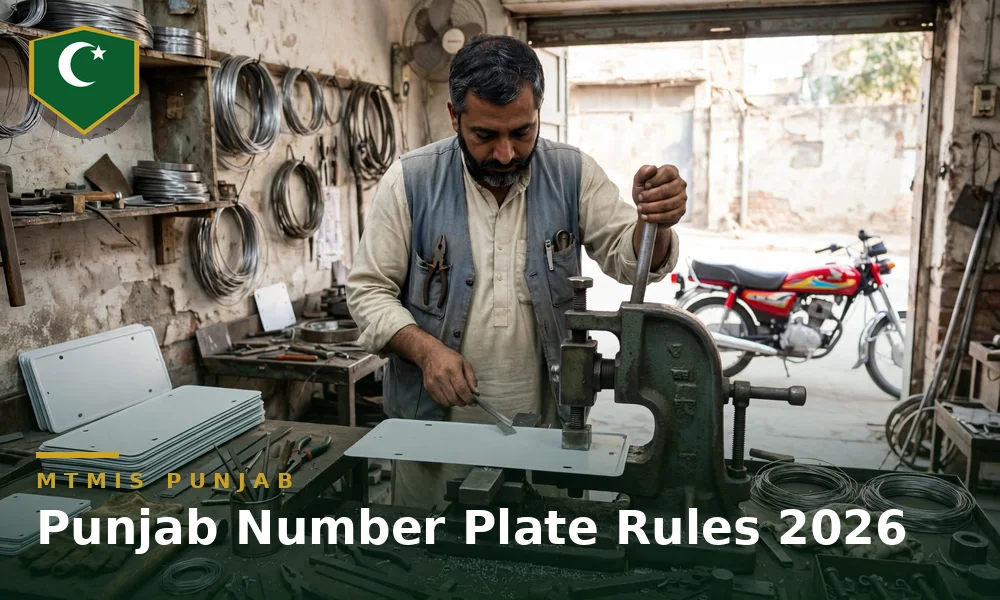
Punjab number plate rules in 2026: the open regime and the approved format
The Punjab Excise, Taxation and Narcotics Control Department ended centralised government number plate production in February 2026 and stopped charging a government plate fee. The Director General Excise and Taxation stated the change in a letter to the Punjab Traffic Police dated 19 February 2026. Owners now obtain physical plates from private plate makers in the open market, and the single condition is strict compliance with the approved Punjab plate format: the prescribed size, material, colour and lettering for the vehicle class. Traffic police check format compliance at the roadside and do not fine a compliant private plate for the sole reason that a private maker produced the plate. This guide states what changed, what stayed the same, the approved format elements, and the plate designs that still draw a challan.
Table of contents
- What changed in February 2026
- What did not change under the open regime
- The approved Punjab plate format
- Motorcycle plate sizes in the Faisalabad advisory
- How to get a compliant plate made
- What traffic police check at the roadside
- Plate designs that still break the rules
- Frequently asked questions
What changed in February 2026
Bloom Pakistan and Pak Spectrum reported the department letter of 19 February 2026 in the same terms. Centralised production of government number plates stands discontinued for cars, motorcycles and heavy vehicles. The department collects no fee for a government-manufactured plate, because the department no longer manufactures the plate. Owners arrange the physical plate themselves from any private vendor, and the vendor applies the approved design to the registration number the department allotted.
The letter answered a live enforcement problem. Reporting by The Express Tribune, carried in guide coverage of the change, records a large backlog of undelivered government plates and repeated roadside disputes where officers demanded an official plate that the department had not supplied. The February direction closed that gap from both sides: the state stopped promising a manufactured plate, and the traffic police stopped fining owners for the absence of one. The registration number itself remains a department allotment in every case. The open regime changes only the manufacture of the physical plate.
What did not change under the open regime
The open regime changes plate manufacture and nothing else in the registration chain. The department still allots the registration number at registration, and the number still enters the MTMIS record against the owner and the vehicle. The registration fee, the token tax position and the smart card fee of Rs 1,300 remain payable under the standard schedules. A private plate maker holds no authority over the number, the record or the dues. The maker manufactures a physical copy of an allotted number, and a plate that shows any number other than the allotted number stands outside the rules entirely.
The approved format also survives the change in full. A privately made plate carries the same obligation as the former government plate: the plate must match the prescribed Punjab design for the vehicle class in size, material, colour and lettering. The department letter directs traffic police to test the plate against the format and against nothing else. A compliant private plate and a former government plate stand in the same legal position at a roadside check.
Duplicate or lost number plates in Punjab covers the replacement route for a damaged or missing plate and the record position behind the physical plate.
The approved Punjab plate format
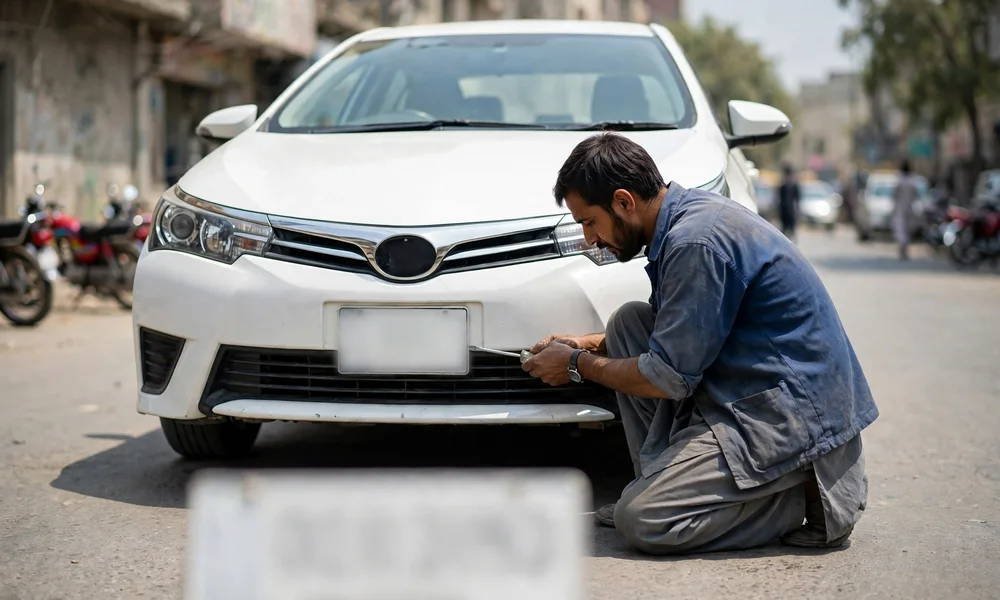
The approved format controls four elements of the plate. Size follows the vehicle class and the mounting position. Material is a metal plate built to carry embossed characters. Colour follows the class scheme of the Punjab design, with private vehicles on the standard white plate with black characters. Lettering uses the prescribed character style and spacing, and the characters stand embossed rather than printed flat. The registration series letters, the number and any prescribed emblem or strip appear in the layout the department design sets for the class.
One precision point matters for buyers of car plates. The department material and the traffic police advisories in circulation state the format elements for every class and state exact dimensions for motorcycle plates. No Excise source in the material checked for this guide publishes a separate millimetre table for car plates. Car plate makers work to the standard Punjab car plate format that the former government plates used, and a buyer compares the finished plate against a former government plate or a maker sample of the approved design before fitting. A buyer should treat any exact car dimension printed on an unofficial blog as unverified until an Excise source states the figure.
Motorcycle plate sizes in the Faisalabad advisory
The Faisalabad Traffic Police advisory, reported by PakWheels, states the approved motorcycle specification in exact figures. The advisory describes a white metal plate with black embossed letters and numbers. The table below states the advisory figures.
| Motorcycle plate point | Advisory specification |
|---|---|
| Rectangular plate size | 205 × 70 mm |
| Character height, rectangular plate | 30 to 35 mm |
| Square plate size | 200 × 170 mm |
| Character height, square plate | 45 to 50 mm |
| Margin around the characters | 10 mm |
The advisory binds the figures to motorcycle plates in the Faisalabad traffic police context. A rider in another district uses the same Punjab format, and the advisory figures give the only exact published dimensions a buyer can check at the maker counter. A plate that departs from the advisory dimensions in size or character height fails the format test on its face.
How to get a compliant plate made
The sequence below states the working order for a replacement or first plate under the open regime.
- Confirm the allotted registration number on the registration book or the smart card. The maker copies this number exactly.
- Select a plate maker who produces plates in the approved Punjab format for the vehicle class.
- State the class specification at the counter: metal plate, embossed characters, the approved colour scheme and the standard layout.
- Check the finished plate character by character against the registration number before payment.
- Fit the plate at the prescribed mounting positions and keep the characters fully visible.
The maker charges a market price for the manufacture, and the price varies by maker and finish. No Excise fee applies to the plate itself after February 2026. A buyer who pays any person a government plate fee after that date pays a charge the department no longer collects.
What traffic police check at the roadside
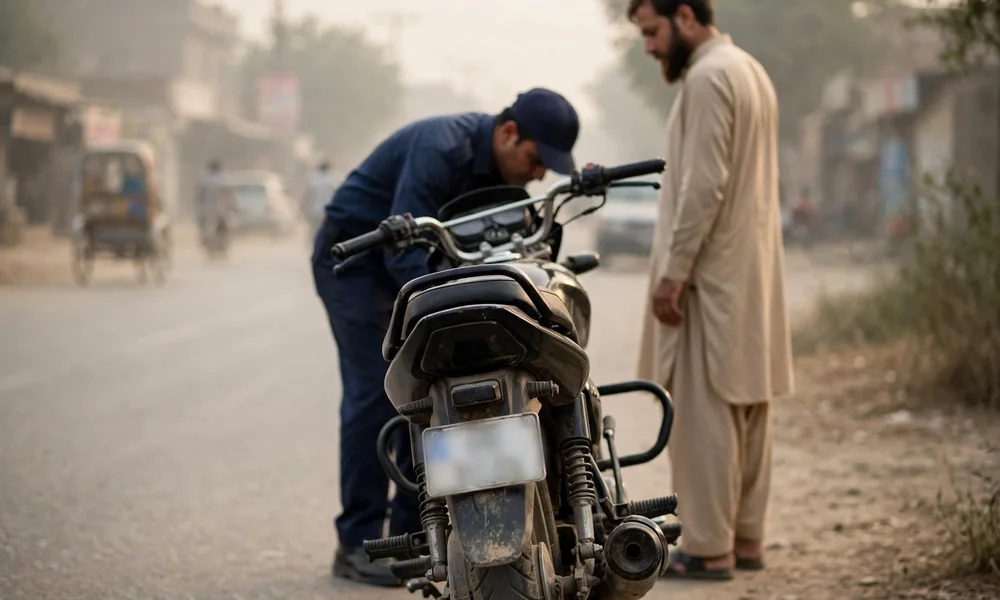
The February 2026 direction sets the roadside test. The officer checks whether the displayed plate conforms to the prescribed Punjab format in design, specification and layout. The officer does not require the motorist to produce a government-manufactured plate, because centralised issuance no longer exists. A compliant private plate passes the check. Bloom Pakistan reported the department instruction in direct terms: no penalty applies to a citizen using a privately made plate that meets the approved criteria.
The format test still has teeth. A plate with a designer font, a wrong colour scheme, missing embossing or characters arranged outside the standard layout fails the test, and the officer issues a challan on the format ground. The origin of the plate is no longer the offence. The design of the plate is the offence where the design departs from the approved format.
How to check and pay a Punjab e-challan online explains the online challan check against a registration number and the payment routes for an issued challan.
Plate designs that still break the rules
The open regime legalises private manufacture, and the open regime legalises no design freedom. The list below states the departures that continue to break the rules.
- Fancy or designer fonts that replace the prescribed character style
- Colour schemes outside the approved class scheme, including tinted or reflective backgrounds added for style
- Flat printed characters in place of embossed characters
- Extra names, slogans, images or graphics anywhere on the plate face
- Characters compressed, spaced or tilted outside the standard layout
- Plates cut to a non-standard size for the vehicle class
Each departure fails the same format test the February letter sets. A buyer who wants a personalised registration mark uses the department e-auction route for the number itself and then has the allotted mark made into a compliant physical plate.
MTMIS Punjab: the complete guide to online vehicle verification covers the record behind the plate, including the verification fields and the reading of the result.
Frequently asked questions
Is a privately made number plate legal in Punjab in 2026?
Yes. The department direction of February 2026 allows plates from any private maker, and traffic police do not fine a compliant private plate for its origin. The plate must match the approved Punjab format in size, material, colour and lettering.
Does the Excise Department still charge a number plate fee?
No. The department stopped charging a government plate fee when centralised plate production ended in February 2026. The owner pays only the private maker for the manufacture of the physical plate.
Does the open regime change the registration number itself?
No. The department still allots the registration number at registration, and the number still stands in the MTMIS record against the owner and the vehicle. The open regime changes only the manufacture of the physical plate that displays the number.
Can a buyer use any design on a privately made plate?
No. The approved format governs every privately made plate. Designer fonts, extra graphics, wrong colours and non-standard sizes fail the format test and draw a challan.
Are the old government-issued plates still valid?
Yes. A government-issued plate matches the approved format by construction, and the plate remains valid. The February change concerns new manufacture, and no owner needs to replace a sound government plate.
Does the smart card fee change under the open regime?
No. The smart card fee stays at Rs 1,300, and the registration fee and token tax positions stay under the standard schedules. The open regime removes the plate fee alone.