BISP registration documents 2026: complete checklist guide
BISP registration documents you need for the dynamic survey
A correct document file settles a BISP registration in a single visit, and a missing paper sends the applicant home empty-handed. This guide serves first-time applicants, widows, and families updating a household record for the Benazir Income Support Programme (BISP) dynamic survey in 2026. However, many applicants carry the wrong papers because agents give incomplete lists at the payment points. I have laid out the full registration documents checklist in a very easy manner, with the exact papers for the main applicant, for children, and for special cases such as widows and disabled persons. Carry the complete file and your survey starts and finishes the same day.
Table of contents
- The core documents every applicant carries
- Documents for children in the household
- Documents for widows and special cases
- The SIM and mobile number rule
- What happens at the registration desk
- Mistakes that send applicants home
- Frequently asked questions
- Key points to remember
The core documents every applicant carries
Every applicant carries three core items to the dynamic survey: her original Computerised National Identity Card (CNIC), one photocopy of the CNIC, and a mobile phone carrying a SIM registered in her own name. The BISP beneficiary is the female head of the household, so the survey record opens in the name and CNIC of that woman. Staff inspect the original card and keep the copy for the case file.
Check every core item before travel. The CNIC must stand valid and unexpired on the day of the visit, because an expired card pauses the survey until NADRA renews the record. Our 8171 registration guide explains the desk steps in full. The photocopy must show both sides of the card clearly, and a blurred copy fails at the scanning desk. The survey itself costs nothing, and no office or agent may charge a fee for registration.
Documents for children in the household
Parents carry the NADRA B-Form, also called the Child Registration Certificate, for every child in the household, and the B-Form data links each child to the family record. The B-Form numbers feed the Taleemi Wazaif stipend eligibility of school-age children, so a missing B-Form delays the stipend even when the survey completes. Carry the B-Form for every child under 18 years of age.
A household with a newborn first obtains the B-Form from the NADRA office or the union council record, then visits the BISP desk. Children above 18 years of age carry personal CNICs instead of a B-Form entry. Staff record the child data exactly as the B-Form prints it, so report any spelling difference between the B-Form and the school record at the desk itself.
Documents for widows and special cases
The standard file changes for three household situations, and each situation adds one paper.
- A widow carries the death certificate of her husband beside her own CNIC.
- A divorced woman carries the divorce certificate or the court decree copy.
- A disabled applicant carries the disability certificate and the special CNIC that carries the disability mark.
- A household that changed its address carries one recent utility bill or a residence proof for the new address.
The widow case deserves one extra warning. The record of the late husband must stand updated at NADRA before the survey, because a CNIC record that still shows a living husband blocks the widow category in the BISP system. Our widow registration guide covers that update in full. Disabled applicants keep the original disability certificate ready for inspection at the survey desk.
The SIM and mobile number rule
The mobile SIM presented at registration must stand registered in the name of the female beneficiary herself, and BISP rejects a SIM registered to a husband, a son, or any other person for the Social Protection Wallet. The wallet and every 8171 payment alert run through this number, so a wrong-name SIM blocks activation later even when the survey succeeds today.
A woman without a SIM in her own name visits the franchise of any mobile operator with her original CNIC before the survey visit. The operator issues a SIM or transfers the number to her name after biometric verification. Our wallet registration guide explains the activation sequence and the deadline for every beneficiary.
What happens at the registration desk
The registration desk follows a fixed sequence, and a prepared applicant completes the full sequence in one sitting.
- Collect the token at the entrance and wait for the token number.
- Present the original CNIC at the desk for the first check.
- Answer the household questions on income, assets, and family members.
- Present the B-Forms and the special-case papers for entry.
- Complete biometric thumb verification at the desk.
- Collect the printed survey receipt before leaving the office.
The survey data feeds the Proxy Means Test (PMT) assessment, and the score decides programme eligibility after processing. The applicant receives the result through the 8171 service in due course. Keep the survey receipt safe across the years, because every later record update starts from the receipt number. Our dynamic survey guide explains the survey rounds and the update rules in full.
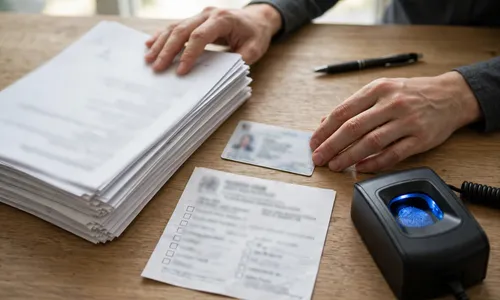
Mistakes that send applicants home
Five mistakes cause most failed visits: an expired CNIC, a missing B-Form, a SIM registered to another person, a blurred CNIC copy, and a missing death certificate in a widow case. Each mistake costs a second journey, and rural applicants lose a full day of wages on every repeat visit. Run the checklist on the morning of travel, paper by paper, against the list in this guide.
One further mistake appears at the payment points. An agent offers fast registration for a cash fee. The offer is a fraud in every case, because BISP registers households only through the official survey at a tehsil office or a dynamic registration centre. Report any demand for money on the complaint helpline 0800-26477.
Frequently asked questions
Does BISP charge any fee for the dynamic survey registration?
No. Registration and the survey cost nothing at every official office. Report any person who demands a fee on 0800-26477.
Can a husband register the household in his own name?
No. BISP opens the beneficiary record in the name of the female head of the household, and Kafaalat payments go to that woman.
What happens when one document is missing on the survey day?
Staff note the missing paper and the applicant completes the survey after supplying that paper. Carry the full file to finish in a single visit.
Does the applicant need photographs for registration?
No separate photographs are required. The office records the beneficiary data from the CNIC and the desk verification during the survey.
Key points to remember
- Carry the original CNIC, one clear photocopy, and a SIM in your own name.
- Bring the B-Form of every child in the household.
- Widows add the death certificate, and disabled applicants add the disability papers.
- Registration is free, and agents cannot register any household.
- Keep the survey receipt safe for every future update.