How to register an imported vehicle in Punjab
Imported vehicle registration Punjab follows a fixed order: Customs clearance comes first, and Excise registration follows customs clearance. The Punjab Excise and Taxation Department registers the vehicle only after Customs releases the vehicle and the Goods Declaration records payment of all taxes and duties. The registration fee follows the standard car schedule, the smart card fee stands at Rs 1,300, and an unregistered imported vehicle carries no MTMIS record until registration ends. This guide covers both document cases and the fee structure inside the wider system in MTMIS Punjab: the complete guide to online vehicle verification.
Table of contents
- Customs clearance comes before Excise registration
- Documents for registration in the name of the importer
- Documents after a sale by the importer before registration
- The registration fee and the taxes for an imported vehicle
- The registration sequence at the Motor Registration Authority
- Late registration and transfer limits for imported vehicles
- The verification check after registration
- Frequently asked questions
Customs clearance comes before Excise registration
Customs clearance creates the foundation for the Excise file. The importer clears the vehicle through Pakistan Customs, pays the taxes and duties, and holds the Goods Declaration as the central proof document. The Goods Declaration, in short form the GD, records the vehicle description and the payment position. The Motor Registration Authority reads the engine number and the chassis number against the GD during inspection, so an error in the GD reaches the Excise record in a direct line. The owner should correct a GD error at the customs stage.
The import permission carries equal weight in the file. Customs issues the import permission, and the permission states the conditions for the import. A scheme import can carry conditions that restrict an early transfer, so the buyer reads the permission terms before purchase. The bill of lading adds the shipment proof, and the invoice adds the purchase proof in a direct purchase from the manufacturer.
Documents for registration in the name of the importer
Case A covers registration in the name of the importer. The official list for case A contains seven items, and the owner assembles the full set before the visit.
- Application in Form F
- Copy of the CNIC of the owner
- Copy of the import permission from Customs
- Duplicate copy of the Goods Declaration in original, showing payment of all taxes and duties
- Copy of the bill of lading
- Copy of the invoice in the case of a direct purchase from the manufacturer
- Payment of the registration fee, the number plate fee, and other taxes
The duplicate GD must stand in original form, because the authority treats the original duplicate as the proof of duty payment. The owner reads the number plate fee and other tax figures from the challan rather than from an estimate. Documents required for vehicle registration in Punjab sets out the wider document rules for Punjab registration alongside the imported vehicle list.
Documents after a sale by the importer before registration
Case B covers a vehicle that the importer sold in unregistered condition. The buyer registers the vehicle in the name of the buyer, and the file proves the sale chain from the importer to the buyer. The official list for case B contains seven items.
- Form F
- Copy of the CNIC of the owner
- Transfer Order Form, in short form the T.O. Form
- Documents showing the sale by the importer
- Copy of the CNIC of the seller, the importer
- Copy of the import permission
- Duplicate copy of the Goods Declaration in original
The sale documents and the T.O. Form carry the extra weight in case B. The authority follows the chain from the import permission and the GD to the sale documents, and a break in the chain stops the file. A buyer should inspect the chain before payment, in particular the match between the names on the import permission, the GD, and the sale documents. A buyer checks the engine number and the chassis number against the GD. The buyer sends the text CNO plus the chassis number to 8521 and reads the reply from the Stolen Vehicle Information System, in short form SVIS, before money changes hands.
The registration fee and the taxes for an imported vehicle
The registration fee for an imported car follows the standard Punjab car schedule, and the value of the vehicle decides the percentage. The table below states the fee bands and the token tax position for each band.
| Engine size band | Registration fee | Token tax position |
|---|---|---|
| Up to 1000cc | 1% of the value of the vehicle | Rs 20,000 lifetime token tax |
| From 1001cc to 2000cc | 2% of the value of the vehicle | 0.3% of invoice price per year |
| Above 2000cc | 4% of the value of the vehicle | 0.4% of invoice price per year |
The smart card fee adds Rs 1,300. Token tax above 1000cc follows the percentage rule in the table, and the ePay challan states the exact amount for the individual vehicle. Capital Value Tax, in short form CVT, applies to a vehicle above 1300cc at 1% of the value of the vehicle. CVT runs for a 5 year period from 1 July of the preceding financial year of registration, with 10% depreciation per year. The owner reads each head on the challan as a separate line before payment.
How to register a new vehicle in Punjab describes the parallel route for a locally sold new vehicle, and a comparison of the two routes shows the customs documents as the main extra layer in an imported case.
The registration sequence at the Motor Registration Authority
The sequence below carries an imported vehicle from customs release to a live MTMIS record.
- Complete customs clearance and hold the GD with the duty payment record.
- Assemble the file for case A or case B, with Form F and the CNIC copies in place.
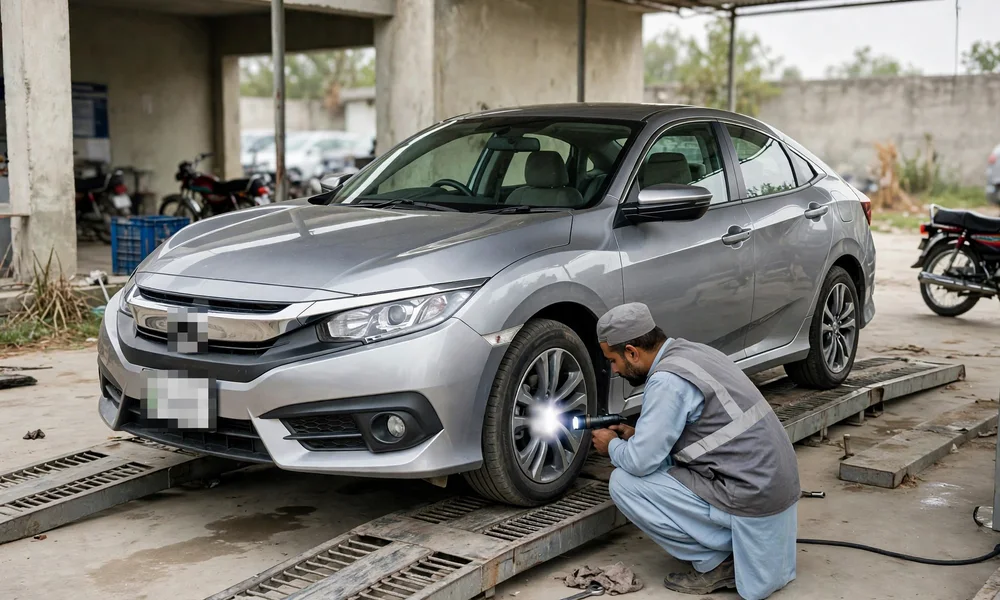
- Present the vehicle for physical inspection at the Motor Registration Authority, and officers verify the engine number and the chassis number against the GD.
- Pay the challan through ePay Punjab against the PSID or at the bank counter.
- Receive the registration number and the number plates from the authority.
- Await the smart card by post, and keep the registration documents with the vehicle.
- Verify the record on the official portal mtmis.excise.punjab.gov.pk at the end of the process.
PSID stands for Payment Slip ID, and the PSID carries 17 digits. The owner keeps the paid receipt with the vehicle file, and the portal epay.punjab.gov.pk generates the challan for the payment.
Late registration and transfer limits for imported vehicles
The late registration additional fee counts from import clearance or release from the customs authorities, rather than from a dealer sale date. The additional fee is a registration charge, and the fee differs from a token tax penalty. For a private vehicle and a commercial vehicle, the schedule charges Rs 2,000 for a delay from 60 days to 180 days and Rs 5,000 for a delay above 180 days. The schedule charges Rs 500 for a motorcycle, a scooter, or a rickshaw after 30 days.
Transfer limits demand the same early attention. Scheme import conditions can restrict an early transfer, and the restriction sits in the import permission rather than in the Excise schedule. A buyer reads the permission terms before purchase and asks the Motor Registration Authority about a transfer bar on the specific vehicle.
The verification check after registration
Registration creates the MTMIS record, and the owner confirms the record at the end of the process. The online verification form on mtmis.excise.punjab.gov.pk asks for the registration number, the registration date, and a security code. The result shows the engine number, and the result does not show the chassis number. The owner checks the engine number in the result against the vehicle documents and reports a mismatch to the Motor Registration Authority without delay. SMS verification offers a second route: the owner sends the registration number to 8785 and reads the reply record.
The Excise helpline 1035 and the PITB helpline 0800-08786 answer process questions, and Police 15 takes emergency calls. The Excise head office stands at Transport House, 11-A Egerton Road, Lahore. An owner keeps the GD copy, the import permission copy, the paid PSID receipt, and the smart card together as one file.
Frequently asked questions
Does an unregistered imported vehicle appear on MTMIS Punjab?
No. An unregistered imported vehicle carries no MTMIS record, because the record begins at Excise registration. The owner relies on the GD, the import permission, and the SVIS check to 8521 before registration.
Does the registration fee for an imported car follow the standard car schedule?
Yes. The registration fee follows the standard car schedule of 1 percent up to 1000cc, 2 percent from 1001cc to 2000cc, and 4 percent above 2000cc, with the value of the vehicle as the base. The smart card fee adds Rs 1,300.
Does a buyer need a Transfer Order Form after a sale by the importer?
Yes. Case B requires the Transfer Order Form, the T.O. Form, documents showing the sale by the importer, and a copy of the CNIC of the importer as seller. The file requires Form F, a copy of the CNIC of the buyer, a copy of the import permission, and the duplicate GD in original.
Does CVT apply to every imported vehicle?
No. CVT applies only to a vehicle above 1300cc. The tax stands at 1 percent of the value of the vehicle for a 5 year period from 1 July of the preceding financial year of registration, with 10 percent depreciation per year.
Does the online verification result show the chassis number?
No. The online result shows the engine number, and the result does not show the chassis number. The owner checks the chassis number on the vehicle and on the GD in person. The SVIS stolen check to 8521 uses the chassis number as the search key.
Does a scheme import carry a transfer restriction in every case?
No. A restriction depends on the conditions in the import permission for the individual vehicle. A buyer reads the permission terms before purchase, because the permission document decides the position for that vehicle.