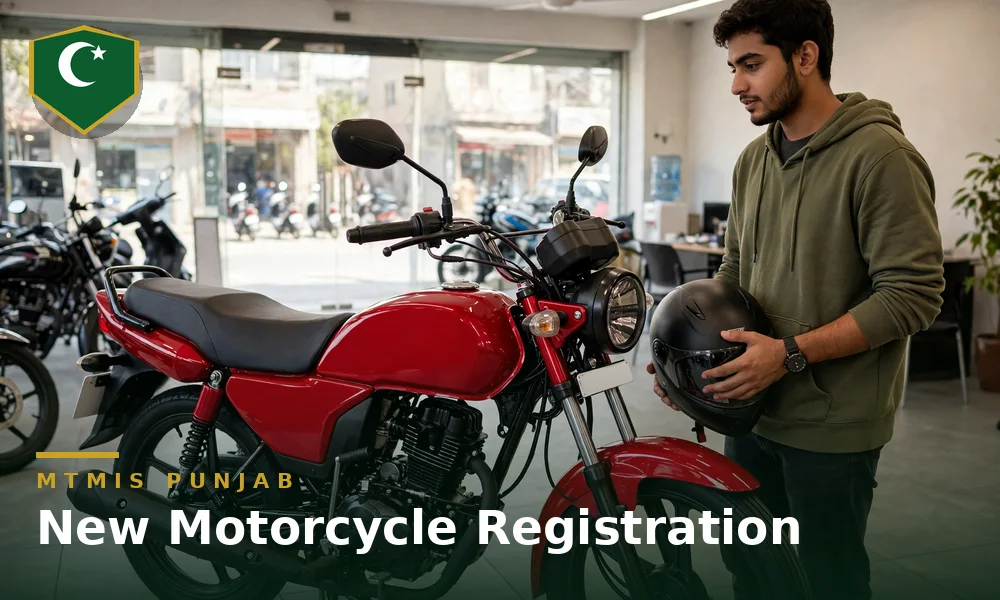
How to register a new motorcycle in Punjab
The motorcycle registration Punjab process charges a fee by engine size, adds lifetime token tax of Rs 1,500 once at registration, and adds a smart card fee of Rs 1,300. A buyer registers a new motorcycle through the selling dealer or in person at the Motor Registration Authority, and the registration creates the MTMIS record for the motorcycle. This guide covers the documents, the fee table, a worked example for a 125cc motorcycle, and the proof checks at the end inside the wider system in MTMIS Punjab: the complete guide to online vehicle verification.
Table of contents
- The documents for a new motorcycle registration
- The fee for a motorcycle by engine size
- A worked example for a 125cc motorcycle
- The two registration routes for a new motorcycle
- The registration steps in person at the Motor Registration Authority
- The late registration charge for a motorcycle
- What the owner receives after registration
- Frequently asked questions
The documents for a new motorcycle registration
The document set for a new motorcycle contains four core items, and the buyer assembles the set before the dealer or the authority opens the file.
- Application in Form F
- Copy of the CNIC of the owner
- Original sales certificate
- Original sales invoice from the dealer or the manufacturer
The sales certificate and the sales invoice carry the identity of the motorcycle in the file. The documents state the engine number, the chassis number, the engine size, and the name of the buyer, and an error in any field reaches the registration record in a direct line. The buyer reads both documents at the point of sale and matches the engine number and the chassis number against the numbers on the motorcycle. A correction at the dealer counter costs minutes, and a correction after registration demands a record amendment at the Motor Registration Authority. The buyer keeps copies of the sales certificate and the sales invoice with the registration file after the process ends.
How to register a new vehicle in Punjab covers the full new vehicle route for cars and motorcycles together, and the motorcycle route in this guide follows the same Excise structure with the motorcycle fee table.
The fee for a motorcycle by engine size
The registration fee follows the engine size of the motorcycle, and the table below states the official bands.
| Engine size | Registration fee |
|---|---|
| Up to 70cc | Rs 1,000 |
| From 71cc to 100cc | Rs 1,500 |
| From 101cc to 125cc | Rs 2,000 |
| From 126cc to 150cc | Rs 2,500 |
| Above 150cc | 2% of the value of the motorcycle |
Lifetime token tax adds Rs 1,500, and the owner pays the amount once at registration rather than each year. The smart card fee adds Rs 1,300. Professional tax adds Rs 200 at registration under the official table for the motorcycle row. The challan on ePay Punjab lists each head as a separate line, and the owner reads the full challan before payment. The portal epay.punjab.gov.pk generates the challan, and payment runs against the PSID. PSID stands for Payment Slip ID, and the PSID carries 17 digits. A dealer service charge stands outside the government heads on the challan, and the buyer asks the dealer to state the charge as a separate figure on the dealer invoice.
A worked example for a 125cc motorcycle
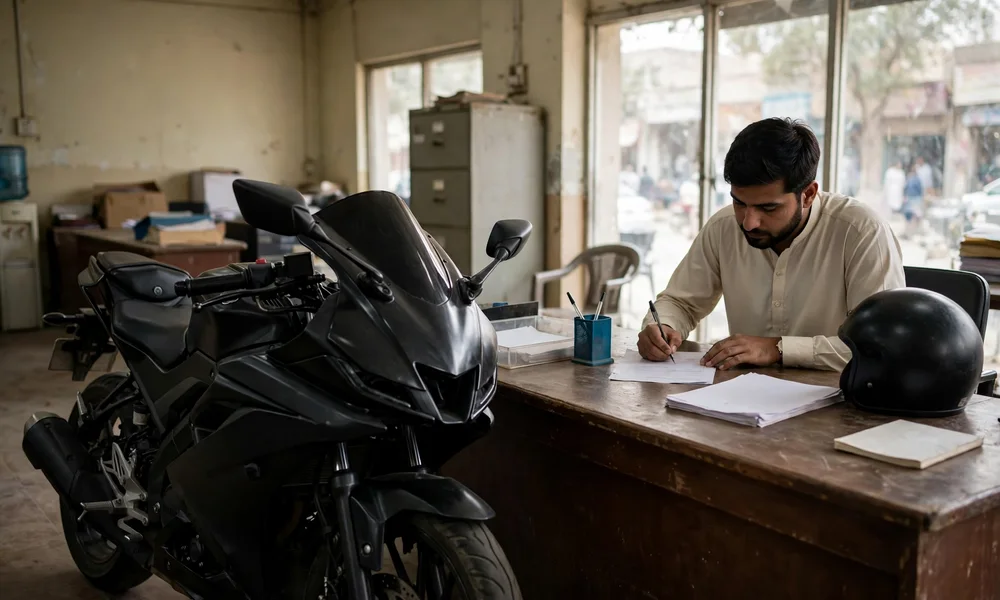
A buyer of a 125cc motorcycle pays Rs 2,000 as the registration fee, plus Rs 1,500 as lifetime token tax, plus Rs 1,300 as the smart card fee. The three amounts total Rs 4,800 in government dues before any dealer service charge. The example uses the most common engine band on Punjab roads, and a buyer of a 70cc motorcycle pays a lower registration fee of Rs 1,000 under the same structure. A buyer of a motorcycle above 150cc pays a registration fee at 2 percent of the value of the motorcycle, so the ePay challan states the exact figure for that motorcycle. The buyer compares the challan lines against the table in this guide and questions a line that matches no official head.
The two registration routes for a new motorcycle
A buyer holds a choice between two routes, and both routes end at the same MTMIS record. The first route runs through the selling dealer. A dealer with registration authority submits the file, collects the government dues, and delivers the registered motorcycle under the dealer registration system. The buyer confirms the authority of the dealer before payment and reads the dealer invoice for a clear split between the price of the motorcycle, the government dues, and the dealer service charge.
The second route runs in person at the Motor Registration Authority for the district. The buyer presents the motorcycle, the documents, and the payment in person, and officers complete the inspection and the registration at the counter. The in person route suits a buyer whose dealer holds no registration authority and a buyer who prefers direct dealing with the authority. In contrast, the dealer route saves the buyer a separate visit, and the buyer trades the visit saving against the dealer service charge. Both routes produce the same registration number series, the same smart card, and the same portal record.
The registration steps in person at the Motor Registration Authority
The sequence below covers the in person route from document check to payment.
- Assemble Form F, a copy of the CNIC of the owner, the original sales certificate, and the original sales invoice.
- Present the motorcycle for inspection, and officers verify the engine number and the chassis number against the sales documents.
- Submit the file at the counter, and the authority generates the challan for the registration fee, lifetime token tax, professional tax, and the smart card fee.
- Pay the challan through ePay Punjab against the PSID or at the bank counter.
- Receive the registration number and the number plate.
- Keep the paid PSID receipt with the motorcycle documents.
The inspection step protects the record. Officers read the stamped numbers on the motorcycle rather than the numbers on a photocopy, so the buyer brings the motorcycle in physical form. A file with a number mismatch stops at inspection, and the buyer returns to the dealer for a document correction before the file moves again.
The late registration charge for a motorcycle
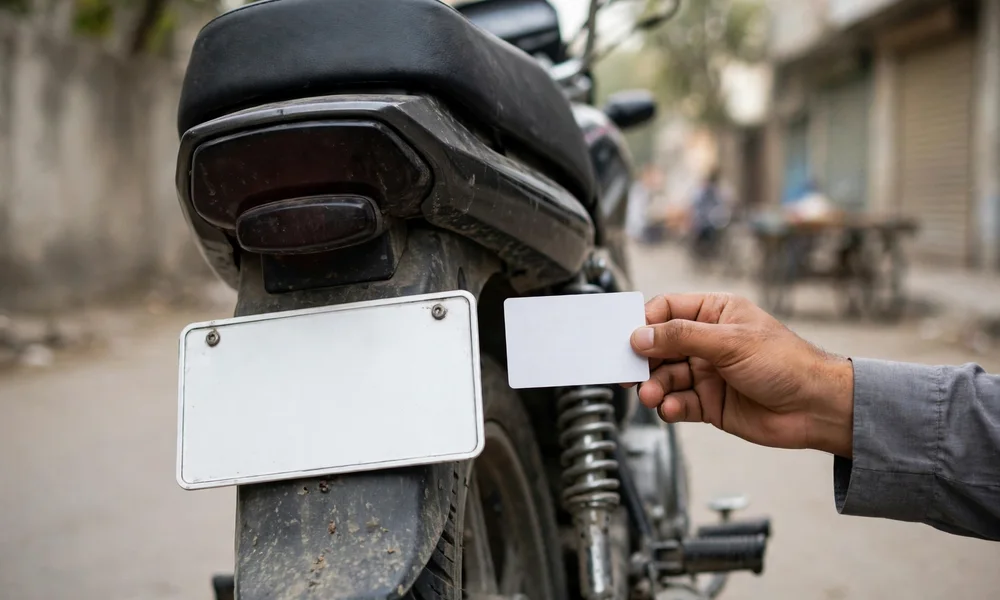
The schedule treats a late motorcycle registration as a registration delay, and the charge stands apart from token tax. A motorcycle registered after 30 days carries an additional fee of Rs 500. The count runs from the sale of the motorcycle, so a buyer who delays the dealer route or the in person route beyond 30 days adds Rs 500 to the bill. The charge gives a clear reason for a prompt registration: the buyer completes the file inside the first month and pays only the standard heads. A dealer who holds a sold motorcycle in unregistered condition passes the delay risk to the buyer, so the buyer agrees the registration date with the dealer at the point of sale and records the date on the invoice copy.
What the owner receives after registration
Registration delivers three forms of proof in sequence. The number plate arrives first, at the counter or through the dealer, and the plate carries the registration number for the motorcycle. The smart card arrives by post, and delivery takes about 2 to 4 weeks as a range rather than a promise. The free e-registration card serves as interim proof during the wait for the smart card, and the owner carries the e-registration card with the paid receipt on the road.
The owner confirms the record at the end of the process. The online verification form on mtmis.excise.punjab.gov.pk asks for the registration number, the registration date, and a security code. The result shows the engine number, and the result does not show the chassis number. The owner checks the engine number in the result against the documents for the motorcycle, because the portal gives no chassis check. SMS verification offers a second route: the owner sends the registration number to 8785 and reads the reply record. Motorcycle verification on MTMIS Punjab explains both routes in full. The Excise helpline 1035 and the PITB helpline 0800-08786 answer process questions, and the Excise head office stands at Transport House, 11-A Egerton Road, Lahore.
Frequently asked questions
Does a buyer pay token tax for a motorcycle every year?
No. A motorcycle carries lifetime token tax of Rs 1,500, and the owner pays the amount once at registration. No annual token tax bill follows for the motorcycle after the registration payment.
Does the dealer route produce the same record as the office route?
Yes. Both routes create the same MTMIS record, the same smart card, and the same registration number series. The dealer route adds a dealer service charge, and the in person route demands a visit to the Motor Registration Authority.
Does a late motorcycle registration carry an extra charge?
Yes. A motorcycle registered after 30 days carries an additional fee of Rs 500. The charge is a late registration fee under the schedule, and the ePay challan shows the charge as a separate line.
Does the online result show the chassis number of a motorcycle?
No. The online result shows the engine number, and the result does not show the chassis number. The owner checks the engine number against the documents for the motorcycle and checks the chassis number on the motorcycle in person.
Does the smart card arrive on the day of registration?
No. The smart card arrives by post after registration, and delivery takes about 2 to 4 weeks as a range. The free e-registration card serves as interim proof during the wait.
Does a buyer need the original sales invoice for registration?
Yes. The file requires the original sales invoice from the dealer or the manufacturer, alongside the original sales certificate, Form F, and a copy of the CNIC of the owner. A photocopy alone does not meet the document list.