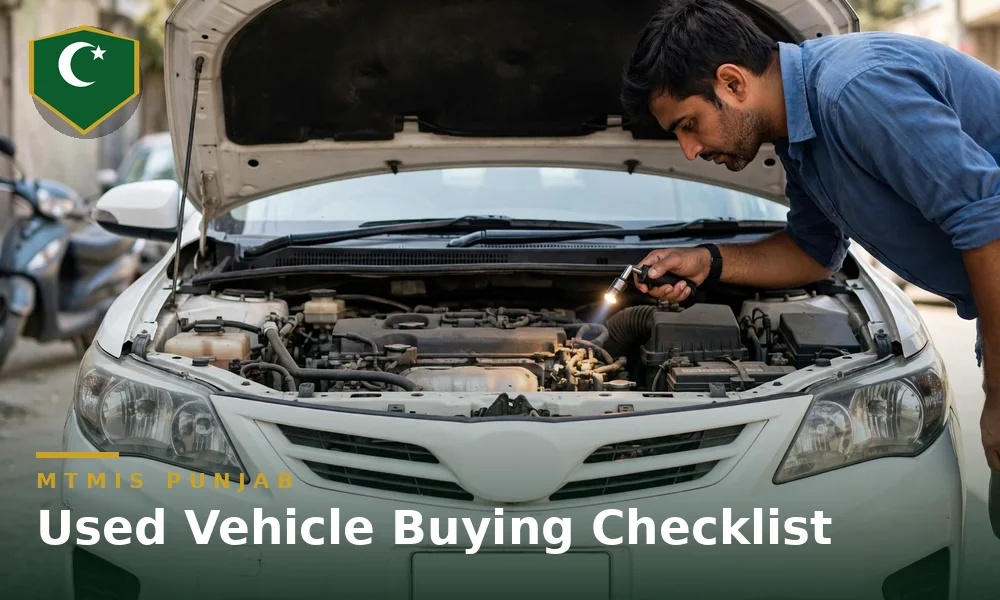
Used vehicle buying checklist: 12 checks before you pay in Punjab
A used vehicle in Punjab carries two separate risks: the metal in front of the buyer and the record behind the metal. A polished car with a broken record can cost more than a rough car with a clean one, because unpaid dues, an open transfer chain and a mismatched engine number all transfer to the buyer with the vehicle. This checklist runs 12 checks in a fixed order, records and numbers first, dues and documents second, physical condition third, and money last. The record checks build on MTMIS Punjab: the complete guide to online vehicle verification.
Table of contents
- The 12 checks at a glance
- Checks 1 to 3: the record and the seller
- Checks 4 and 5: the stamped numbers on the vehicle
- Checks 6 and 7: the dues on the record
- Checks 8 to 10: documents and legal status
- Check 11: physical condition and the test drive
- Check 12: transfer readiness and safe payment
- Red flags that end the deal
- Frequently asked questions
The 12 checks at a glance
The full list fits on one page, and a buyer can complete the first seven checks before visiting the vehicle a second time.
The 12 checks in working order:
- Verify the vehicle on the MTMIS portal.
- Cross-check the record by SMS to 8785.
- Match the seller to the registered owner.
- Match the engine number on the vehicle.
- Match the chassis number on the vehicle.
- Read the token tax status.
- Search the e-challan record.
- Inspect the original registration document.
- Clear the bank lien question.
- Verify import documents on an imported vehicle.
- Inspect the vehicle physically and test drive it.
- Confirm transfer readiness and pay through a traceable channel.
Checks 1 to 3: the record and the seller
Check 1: verify the vehicle on the MTMIS portal. The buyer enters the registration number, the registration date and the security code on the official portal and reads the full result. The owner name, make, model, color and engine number on the result form the reference set for every later check. How to verify a vehicle online on MTMIS Punjab, step by step walks through the form and the result blocks.
Check 2: cross-check the record by SMS to 8785. The buyer sends the registration number by SMS to 8785 from a personal phone and compares the reply with the portal result and with the documents the seller presents. Two independent channels returning the same record reduce the value of a doctored screenshot or a printed page. The method is set out in vehicle verification by SMS.
Check 3: match the seller to the registered owner. The seller should be the registered owner, and the buyer should see the original Computerized National Identity Card (CNIC) in person rather than a photograph of one. A seller who is not the registered owner points to an earlier sale that never reached the record, the open letter pattern that leaves the legal owner unchanged while the vehicle changes hands. That chain must close before money moves, because the buyer inherits every break in it.
Checks 4 and 5: the stamped numbers on the vehicle
Check 4: match the engine number on the vehicle. The engine number is stamped on the engine block, and the buyer reads it digit by digit against the portal result and the registration document. A different engine number usually means an engine swap that the record never absorbed, and an unrecorded swap blocks a clean transfer until the department records the change.
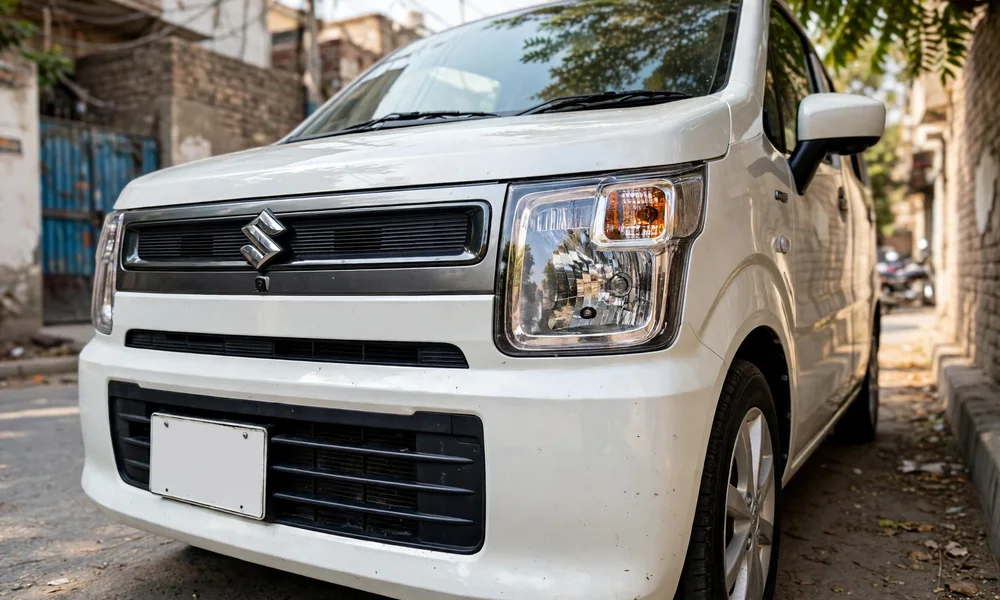
Check 5: match the chassis number on the vehicle. The chassis number is stamped on the frame or the body shell, on a motorcycle on the steering head and on a car typically in the engine bay or on the frame rail. The buyer reads the physical stamping against the registration document, because the online result does not publish the chassis number. Shallow, uneven or ground-down stampings suggest re-stamping, and a re-stamped chassis ends the deal regardless of price. The buyer also checks the stamping area for welding or fresh paint.
Checks 6 and 7: the dues on the record
Check 6: read the token tax status. The verification result shows the token paid up to date. Arrears stay attached to the vehicle record, and the buyer who accepts a vehicle with unpaid token tax accepts the arrears and the surcharge on them. The clean pattern is settlement by the seller before transfer, or a written price adjustment that prices the arrears and the surcharge into the deal. The method appears in how to check token tax online in Punjab.
Check 7: search the e-challan record. Camera challans accumulate quietly on Lahore-registered vehicles in particular, and the buyer searches the registration number on the Safe City e-challan service before payment. Outstanding challans follow the record in the same way as tax arrears. The search and payment route appears in how to check and pay a Punjab e-challan online.
Checks 8 to 10: documents and legal status
Check 8: inspect the original registration document. The buyer inspects the original smart card or registration book, never a photocopy alone, and compares every printed field with the portal result: registration number, owner name, engine and chassis numbers, make, model and registration date. A duplicate document is legitimate in itself, but the buyer asks why it was issued and runs the same record cross-checks on it.
Check 9: clear the bank lien question. A vehicle bought on bank finance carries a hire purchase agreement (HPA) entry, and the bank holds a claim until termination. The buyer asks directly about finance, looks for the HPA marking on the record or document, and requires the bank clearance or no objection certificate (NOC) before payment. A vehicle under an active lien cannot transfer cleanly.
Check 10: verify import documents on an imported vehicle. An imported vehicle needs its customs trail: the goods declaration, the duty payment evidence and, where the seller claims one, the auction sheet with a chassis reference that matches the vehicle. A non-custom-paid vehicle carries no lawful import trail, cannot transfer through the normal record, and exposes the buyer to seizure. A missing paper trail on an imported vehicle is a stop condition, not a negotiating point.
Check 11: physical condition and the test drive
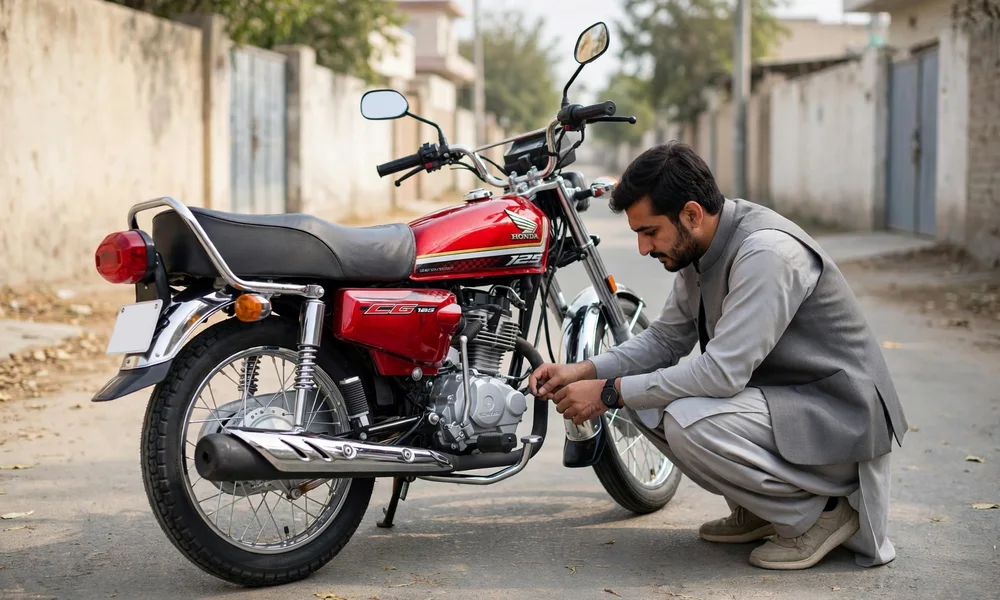
Check 11: inspect the vehicle physically and test drive it. The record checks prove the vehicle is lawful; this check prices the vehicle. The buyer or a trusted mechanic examines panel alignment and paint consistency for accident repair, weld marks and overspray, rust under the body, oil leaks, exhaust smoke color, suspension noise, tire wear and air conditioning performance. Wear on the steering wheel, pedals and driver seat that contradicts a low odometer reading points to meter tampering. A test drive on city streets and an open road exposes gearbox, braking and overheating faults that a parked inspection hides. A seller who refuses an independent mechanic inspection supplies the answer to this check without a spanner being lifted.
Check 12: transfer readiness and safe payment
Check 12: confirm transfer readiness and pay through a traceable channel. Punjab transfer runs on biometric verification, and the seller completes a biometric step for the transaction to proceed. The buyer confirms before payment that the registered owner is available and willing to complete that step, because a paid vehicle with an absent owner is an asset the buyer cannot register. The closing pattern is a written sale agreement naming both parties, the vehicle and the price, payment through a bank transfer or pay order rather than untraceable cash, and a transfer appointment kept by both parties. The full transfer sequence appears in how to transfer vehicle ownership in Punjab.
Red flags that end the deal
Certain findings close the negotiation rather than discount it:
- A chassis stamping that looks re-stamped, ground or welded
- A registered owner who cannot be produced for biometric verification
- An imported vehicle with no customs paper trail
- A price far below the market for the model and year, paired with pressure to close quickly
- A seller who refuses the portal check, the SMS check or an independent inspection
Each red flag attacks the one asset the buyer is actually purchasing, which is a clean and transferable record.
Frequently asked questions
Which check should a buyer run first?
The MTMIS portal verification comes first, because the result supplies the reference values for the seller match, the stamped number comparisons and the token tax reading. A vehicle that fails the record checks never reaches the physical inspection stage, and the buyer spends no inspection money on a vehicle with a broken record.
Does the online result show the chassis number?
No. The online result shows the engine number and withholds the chassis number. The buyer compares the chassis number between the physical stamping and the registration document, and treats those two sources as the authority for that field.
Who pays the token tax arrears on a used vehicle?
The arrears stay on the vehicle record and pass to the buyer at transfer, because the record must stand clear for the new owner. Buyers normally require the seller to clear the arrears first or reduce the price by the arrears and surcharge in the written agreement.
Can a buyer check e-challans without the seller present?
Yes. The e-challan search runs on the registration number through the Safe City service, and the result shows the outstanding challans against the vehicle. The buyer runs this search during the record checks, before any payment discussion.
Is a photocopy of the smart card enough for the document check?
No. A photocopy or a phone photograph supports an early conversation only. The document check requires the original smart card or registration book, compared field by field with the portal result before payment.