Gujranwala is one of the largest industrial cities in Punjab, and the Gujranwala vehicle fleet sits in the same MTMIS Punjab database as every other district of the province. No separate MTMIS Gujranwala portal exists, and a Gujranwala-registered vehicle verifies on the provincial portal at mtmis.excise.punjab.gov.pk with the registration number, the registration date and the security code. The Motor Registration Authority (MRA) Gujranwala holds the file of each Gujranwala registration for the counter work that stays offline. Industry and the Grand Trunk Road corridor give the city a fleet with a heavy share of commercial and goods vehicles beside private cars, and a buyer in that fleet reads the ownership field and the token tax paid-up-to field with particular care. This guide covers MTMIS Gujranwala: the verification routes, the Gujranwala Excise touchpoints, the cases that need an office visit and the checks before a used vehicle purchase.
Quick answer: One provincial portal verifies Gujranwala vehicles. Open mtmis.excise.punjab.gov.pk and enter the registration number, the registration date printed on the smart card or registration book, and the security code shown on the page. The result shows the owner, vehicle and token tax details and the engine number, but no chassis number.
Table of contents
- One portal for Gujranwala and all of Punjab
- How verification works for Gujranwala-registered vehicles
- Motorcycle verification in Gujranwala
- Number plate check in Gujranwala
- Smart card status check
- Token tax in Gujranwala
- Gujranwala Excise and MRA touchpoints
- When an office visit is required
- Buying a used vehicle in Gujranwala
- Frequently asked questions
One portal for Gujranwala and all of Punjab
No separate MTMIS Gujranwala website exists, and any page that presents itself as one is a guide site or a copy. Gujranwala-registered vehicles verify on the provincial portal, alongside vehicles from Lahore, Multan, Rawalpindi and every other district, because every district Motor Registration Authority feeds one central database. The Excise, Taxation and Narcotics Control Department maintains the database with the Punjab Information Technology Board (PITB), and the district of registration changes nothing in the route of the check.
Gujranwala registrations are easy to recognise in the record. Older district series carry the GJR prefix widely associated with Gujranwala registrations, and the city has run through many series since that format. A reader copies the number from the plate or the smart card rather than from memory, because one wrong letter sends the search to a different series and returns the wrong vehicle or no vehicle at all.
How verification works for Gujranwala-registered vehicles
The online process is the provincial one, and it takes about a minute:
- Open the official portal at mtmis.excise.punjab.gov.pk.
- Select the vehicle verification option on the home page.
- Enter the registration number exactly as it appears on the plate or the smart card.
- Enter the registration date printed on the smart card or registration book.
- Enter the security code shown on the page.
- Submit the search and read the record that returns.
The record shows the owner name and city, the make, model and year, the engine number, the token tax paid-up-to date and any live application against the vehicle. The online result does not display the chassis number, so a reader compares the chassis number on the card or book with the stamping on the frame of the vehicle.
SMS verification runs beside the portal. The reader sends the registration number to 8785 and receives the record by message. The SMS route suits a roadside check at the vehicle, and the portal route suits a full reading of the record before payment. Both routes read the same central database, and neither route charges a fee.
How to verify a vehicle online on MTMIS Punjab, step by step walks through every field of the result, including the fields a Gujranwala buyer reads first.
A buyer of a goods vehicle reads the token tax paid-up-to date first, because arrears on the record pass into the hands of the new owner at transfer. The buyer then reads the owner field against the seller or the transport company on the other side of the deal, and a fleet buyer repeats the reading on every vehicle, because one clean sample record says nothing about the rest of the fleet.
Two records describe a Gujranwala vehicle. The Excise record covers registration, ownership and token tax. Camera-issued traffic fines sit in a separate record held by the Punjab Safe Cities Authority for the camera-enforced areas where the vehicle has run, and a goods vehicle that runs into Lahore can carry fines in that record. A clean Excise record says nothing about unpaid camera fines, so a buyer checks both records before a purchase.
Motorcycle verification in Gujranwala
Motorcycles form a large part of the Gujranwala fleet beside the commercial vehicles, and the check runs in exactly the same way as a car check. Enter the registration number and the registration date on the same portal form, or send the registration number by SMS to 8785. The result shows the owner name, the make and model, the engine number and the token tax position. Motorcycles pay a lifetime token tax of Rs 1,500 at registration, so a motorcycle record should show no annual token dues. Match the engine number in the result with the stamping on the engine before any money changes hands. The guide to motorcycle verification on MTMIS Punjab covers the extra checks that matter on a bike, including the frame number comparison.
Number plate check in Gujranwala
A number plate check in Gujranwala starts from the same record as a full verification. Read the number exactly as it is stamped on the plate, including the series letters, and enter it with the registration date on the portal. A wrong series letter is the most common reason a Gujranwala search returns no record. Public listings commonly report the older Gujranwala series in the table below.
| Prefix | Commonly reported association | Example format |
|---|---|---|
| GJR | Gujranwala | GJR-1234 |
Treat the table as a guide to what is seen on the road, not as a rule. Punjab has issued a universal province-wide series since 17 August 2020, so a Gujranwala vehicle registered after that date may carry none of these letters, and the district of registration recorded in MTMIS decides which MRA office owns the file. The guide to number plate information in Punjab explains what each part of a plate means.
Smart card status check
A Gujranwala smart card application is followed on the portal. Open the application tracking service, enter the tracking ID from the application receipt, and read the current status, which moves from challan payment through printing to dispatch. The smart card fee is Rs 1,300, and the printed card is delivered by post, usually in about two to four weeks. A card that cannot be delivered is returned, after which it is collected from the MRA office of the district of registration. While the card is in transit, the free e-registration card serves as proof of registration. Returned card tracking is set out in smart card application and delivery tracking, and the card itself is explained in the vehicle registration smart card guide.
Token tax in Gujranwala
The verification record shows the token tax paid-up-to date of a Gujranwala vehicle, and ePay Punjab prices every unpaid year with its surcharge. Under the token tax structure for 2026-27 published by the department, cars up to 1000cc pay a one-time lifetime token tax of Rs 20,000, cars from 1001cc to 2000cc pay 0.3 percent of the invoice price per year, and cars over 2000cc pay 0.4 percent of the invoice price per year. Motorcycles pay a lifetime token tax of Rs 1,500 at registration. Payment runs against a 17-digit PSID through a bank application, an ATM or a mobile wallet. How to check token tax online in Punjab walks through the check, and the Punjab token tax calculator gives an estimate for a vehicle before the ePay figure is generated.
Gujranwala Excise and MRA touchpoints
Most Gujranwala work no longer needs an office, because verification, dues and payments run online. A counter case runs through the touchpoints below.
- Motor Registration Authority Gujranwala. The district registration authority handles the file-level work for Gujranwala-registered vehicles: registration, transfer support, duplicate documents, endorsements and record correction. The district Excise and Taxation Officer heads the district office, and the official department listings place the district office inside a Gujranwala directorate that covers the neighbouring districts.
- Department head office, Transport House, 11-A Egerton Road, Lahore. The provincial head office carries policy matters, escalations and complaints that the district office cannot settle, and the department helpline is 1035.
- Facilitation centres. Biometric verification for transfers and a range of counter services run at facilitation centres, and the PITB helpline 0800-08786 confirms the nearest working centre for a Gujranwala applicant.
- Online first. Verification runs on the portal, dues and payments run through ePay Punjab, and an appointment can be booked before a counter visit, so counter time goes to the file rather than to a queue.
An owner confirms the current counter position for a series on the department website or on helpline 1035 before travel, because district counter arrangements change over time and this guide prints no street address that a change would falsify.
When an office visit is required
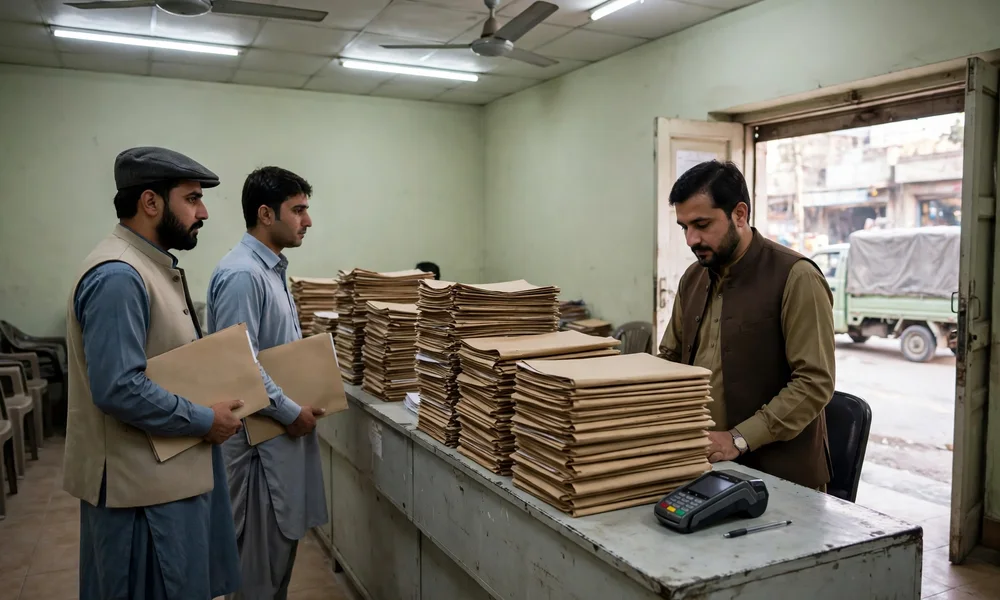
Some problems cannot close on the portal, and an office visit to the MRA Gujranwala is required in these situations.
- The record does not exist online. Very old Gujranwala vehicles that were never digitised confirm against the paper file at the MRA office alone.
- The record is wrong. An incorrect engine number, colour or owner detail corrects on the file by the registering authority, supported by documents and, where the case needs one, a physical inspection of the vehicle.
- The chassis or engine stamping does not match the record. A mismatch is an inspection matter. The department verifies the vehicle physically before any correction, and a buyer never accepts a promise that the office will sort the mismatch out after the sale.
- A complete CNIC-linked list is needed. The open portal limits the personal data on display, and an owner who needs formal confirmation of every vehicle recorded against a CNIC attends the MRA with the original CNIC.
- A card or book stands lost, or a returned smart card awaits collection. Duplicate documents and undelivered cards issue through the office of the district of registration.
The visitor carries the original smart card or registration book, the CNIC of the registered owner and the vehicle itself where an inspection is likely.
Buying a used vehicle in Gujranwala
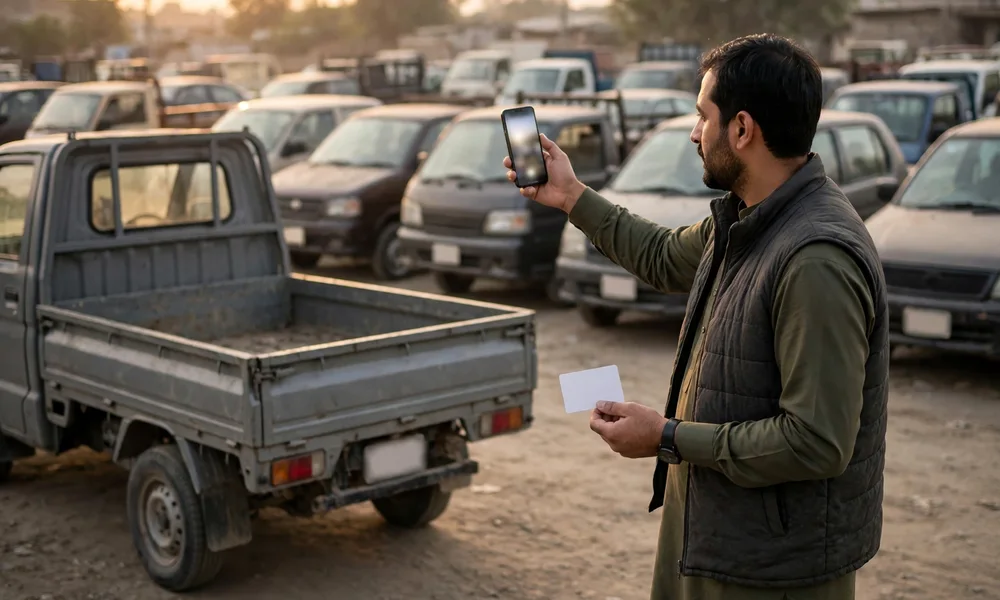
Gujranwala runs a busy used vehicle trade along its industrial corridors, where commercial vehicles change hands beside cars and motorcycles. The buyer runs the online check at the vehicle, never from a screenshot the seller supplies, because a screenshot can come from a different vehicle or an earlier date. The buyer matches the owner name to the CNIC of the seller, the engine number on the result to the stamping on the engine, and the chassis number on the card to the stamping on the frame. The buyer checks the token tax paid-up-to date on the result, then checks the separate e-challan record where the vehicle has run in a camera-enforced area.
A fleet purchase raises the stakes of the same check. A transport company or a factory that buys several goods vehicles runs the verification on each vehicle and settles the token tax position of every unit on paper before payment. One vehicle with open dues or a stranger on the record weakens the whole purchase.
The transfer completes biometrically after purchase. An open letter leaves the record, and the legal risk, with the seller, and the record then shows a stranger as the owner of a vehicle the buyer paid for. A buyer in Gujranwala applies the same rule as a buyer in Lahore: documents first, payment after, transfer on the record before the vehicle changes hands in any lasting sense.
MTMIS Punjab: the complete guide to online vehicle verification covers the full system behind the Gujranwala check, including registration, token tax and transfer in one place.
How to check and pay a Punjab e-challan online covers the camera fine record that stands separate from the Excise record.
Frequently asked questions
How do I check MTMIS Gujranwala online?
Open mtmis.excise.punjab.gov.pk and select the vehicle verification option. Enter the registration number of the Gujranwala vehicle, the registration date printed on the smart card or registration book, and the security code shown on the page. The result shows the owner name and city, the make, model and year, the engine number and the token tax paid-up-to date. No separate Gujranwala login or Gujranwala portal exists.
Is there a separate MTMIS Gujranwala portal?
No. Gujranwala vehicles verify on the single provincial portal at mtmis.excise.punjab.gov.pk, because every district Motor Registration Authority feeds the same central database. Pages that present themselves as a separate Gujranwala portal are guide websites, not government services.
Where does the file work for a Gujranwala vehicle run?
The file work runs at the Motor Registration Authority Gujranwala, the registering authority of the district. Registration, transfer support, duplicate documents and record correction for a Gujranwala-registered vehicle stay with that authority, and the department head office in Lahore handles policy and escalation.
Why does a Gujranwala vehicle show no record online?
A reader first checks the series letters and the registration date for typing errors, because one wrong character returns an empty result. Correct inputs with an empty result point to an old registration that was never digitised, and the MRA Gujranwala confirms such a vehicle against the paper file. A vehicle registered outside Punjab also returns nothing on this portal.
Can token tax for a Gujranwala vehicle be paid without an office visit?
Yes. Dues calculate and pay through ePay Punjab for private and commercial vehicles alike, and ePay Punjab issues a 17-digit PSID that a bank application, an ATM or a mobile wallet accepts. The payment then reflects in the verification record of the vehicle.
Does a clean MTMIS record mean a Gujranwala vehicle has no fines?
No. The MTMIS record covers registration, ownership and token tax, and camera-issued fines sit in the separate Punjab Safe Cities Authority e-challan record for camera-enforced areas. A purchase check covers both records, because the two systems do not clear each other.
Does the verification result show the chassis number of a Gujranwala vehicle?
No. The result shows the engine number and the record fields of the vehicle, and the result shows no chassis number for any Punjab district. A buyer reads the chassis number on the smart card or registration book and matches the number against the stamping on the frame.
How long does a Gujranwala smart card take?
Delivery usually takes about two to four weeks, depending on printing and postal load, and the same timelines apply in Gujranwala as in the rest of Punjab. Track the card on the portal, and use the free e-registration card as proof of registration while the printed card is in transit.